What is the Problem?
 According to a recent study, our children are far more likely to be the target of a bully on-line than to be the target of a sexual predator. The results of such bullying can be just as devastating. This research certainly grabbed my attention as I hope it has yours.
As parents, we need to be aware that cyber-bullying may be occurring in our homes without our even knowing it, and we must do our best to protect our children from both sexual predators and cyber-bullies.
What is Cyber-Bullying?
Cyber-bullying is the spreading of embarrassing, humiliating, harassing, or damaging communication via the internet or via cell phones by text or picture messages. Cyber-bullying has resulted in skipped school, ruined friendships and in at least two documented cases, suicide.
Ideally we would like to minimize our children’s chances of being the victim of cyber-bullying.
But the problem is huge and chances are that our children will experience cyber-bullying at some point during their school career. If they do, we want to maximize the likelihood that they will come to us or a trusted adult to help them deal with it.
What Can You Do?
While nothing can guarantee that our children will not be cyber-bullied, there are many things parents can do to lessen the likelihood that it will happen and to minimize its effects if it does occur.
Parents can:
-
maintain open and honest communication,
-
teach about Internet safety and cyber-bullying,
-
build self-confidence,
-
establish enforceable rules,
-
and keep the computer in a central easily monitored location.
Listening
Listening is probably the most important tool we can use when helping our children to deal with bullying – or most anything else, for that matter.
The skill of active listening encourages our children to keep talking and get beneath surface chatter. In its simplest form, active listening is total focus on the child and reflecting back in a tentative non-judgmental way what we think s/he is saying or feeling.
By listening, rather than leading the conversation, we give our child the time, attention and security necessary to get to the bottom of the real issues.
Discussing
We need to keep the conversation going with our children regarding the dangers – and fun – of the internet. Revisit the issues periodically to keep the lines of communication open about cyber-safety; remember that as your children grow, the issues that they face on-line will continue to change.
As you talk with your children, ask questions – not ones with “yes” or “no” answers, but “what do you think of…”or “tell me about…”
Teaching Internet Safety
-
Talk about the 4P’s – privacy, predators, pornography, pop-ups.
-
Find out about their online friends – who are they? Do they treat your child with respect?
-
Tell them not to give out any personal details or post information that they would not want EVERYONE to know.
-
Be up front – let them know that you will investigate files, buddy lists, online activities, review postings.
Helping Children to Manage Cyber-bullying
-
Discuss the potential dangers and consequences of online bullying.
-
Take threats seriously, even those that are meant to be ‘joking’ – others may not know it’s a joke.
-
Do not retaliate – this only allows the bully to justify his behavior and the victim is seen as contributing to problem.
-
Try ignoring the bully.
-
If ignoring the bully isn’t working, respond assertively and calmly – anger shows weakness.
-
Identify which responsible adults the child might feel comfortable talking to – teachers, school counselors, coaches.
-
Help another child who is being bullied by confronting the bully if they feel comfortable; or reporting it to an adult.
Building Self-Confidence
We can help bully-proof our children by building self-confidence. Let your child know that you value her/him just because s/he is part of your life. Find areas where s/he can excel. Teach your child the skills of problem solving, decision making and assertive behavior.
Model healthy self-esteem by valuing yourself, assertively standing up for yourself, and not allowing others to put you down, so your child knows what healthy self-esteem looks like.
Enforcing Rules
Take a strong, unequivocal stance against bullying so your child knows exactly where you stand on the issue. Realize that in cyber world, the victim one day is often the bully the next.
Discuss rules and solicit your child’s input. Hold your child accountable when rules are not followed. Be careful about how you handle self-reported behavior. Children may not report behavior if they are afraid of being punished. In most cases, what children really need are help and guidance.
The following rules may help:
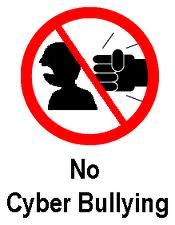
-
Ignore communication from people they don’t know
-
Report cyber-bullying, threats, or other questionable behavior
-
Do not pass along pictures or messages that may be hurtful to another child
-
Promote ‘netiquette’ – online polite, respectful behavior
-
Ask for help from an adult
Finally, keep computers in common areas of the house so monitoring can occur more easily and naturally. Restrict incoming communication with the use of software or programs designed to filter out bad or unknown internet users.
But remember, filtering software is not perfect. Our children are savvy. We cannot rely solely upon outside programs to keep them safe. They need our guidance and vigilance.
Detecting Cyber-bullying
We as parents need to be alert to the possibility that our child is being cyber-bullied. We need to look for changes in our child’s behavior and determine if s/he is:
-
spending more or less time online,
-
avoiding school or activities,
-
appears depressed,
-
or frequently switches screens when someone walks in the room.
If you think your child is being bullied, talk to your child in a clear, straightforward, and honest way about the situation. Your child needs to know you and other trusted adults are strong sources of support and help.
A Parting Thought
Children and teens need help preventing further abuse before a situation gets out of control. Kids need to be reminded that spreading hurtful messages to others will only cause the problem to escalate.
Screen shots of the materials posted should be taken, or email and instant messages should be saved. The abuse can then be reported to the school and/or police so they can help deal with the problem.
The internet can be educational and fun. With open communication, rules, and awareness, we as parents can also help keep it safe.
<return to top of page
____________________________________________________________
For more information about cyberbullying, check out the following books. Purchasing books from Amazon.com through our website supports the work we do to help parents do the best job they can to raise their children.
For Parents:


For Preteens-Teens:


<recommended books about bullying and cyber-bullying
<all our recommended parenting books
<additional online resources about bullying and cyber-bullying
____________________________________________________________
<return to top of page
